I’ve always been a tinkerer. I like to learn by building things.
The other day, I wondered how much of an impact LLM-aided development has had on my side projects. I know I’ve worked on, uh, quite a few things, but I hadn’t actually counted up.
So I checked.
In the past 18 months, I’ve worked on 73 different projects. Some of them, admittedly, didn’t make it much past the wild hair idea phase, but still - over the past 18 months, I’ve committed 1.4 million lines of code to my various side projects. And most of it in the past 10 months.
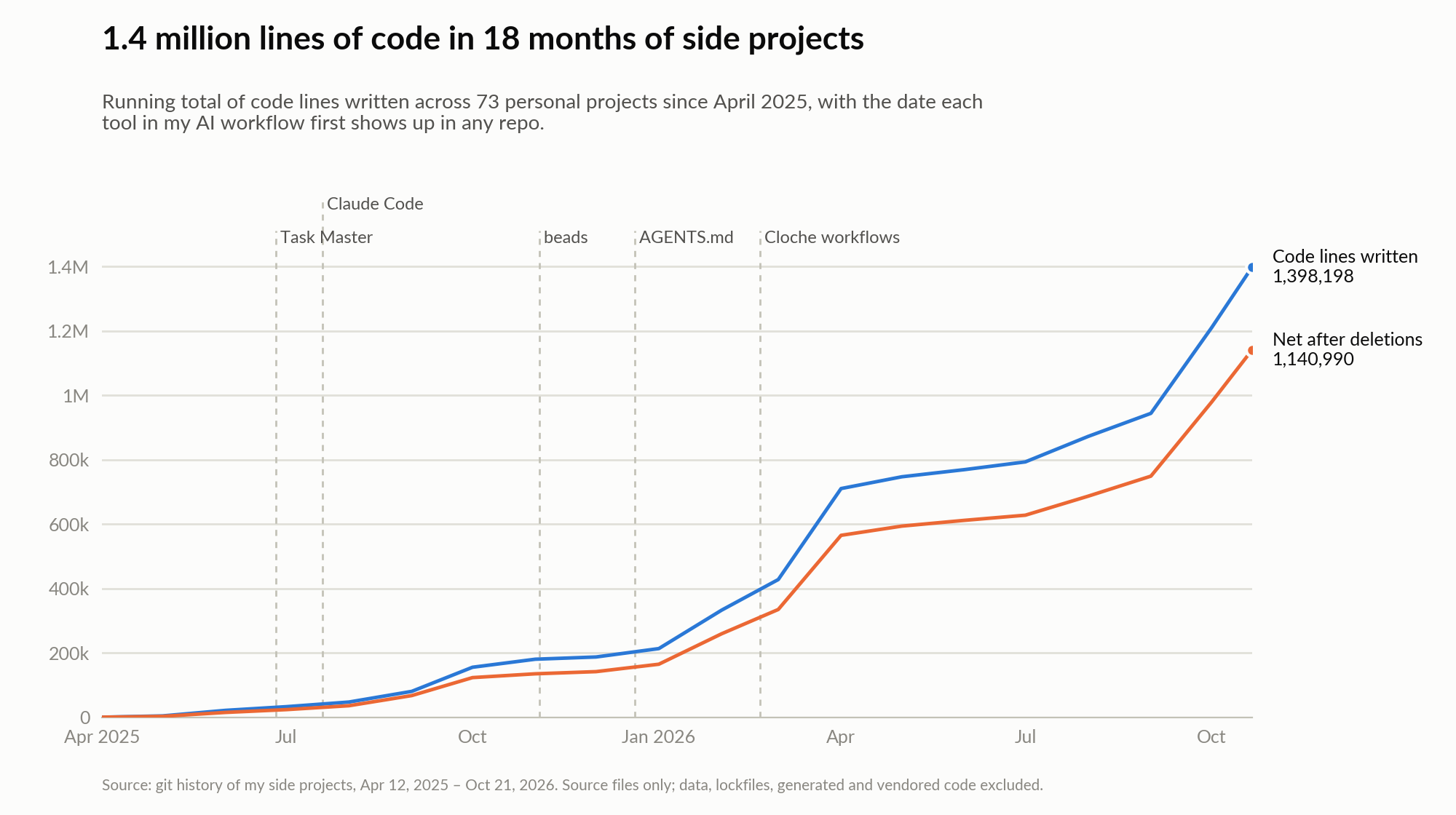
That graph marks the points where I adopted certain tools and it exposed some interesting correlations.
Firstly, from April -> July of ‘25, most of my use of LLM-aided development was in tools such as Windsurf, which provided essentially turbo-charged auto-complete. My rate of development wasn’t notably faster during that time. Two things did start to move the needle - the adoption of TaskMaster and, shortly thereafter, Claude Code. TaskMaster showed me the power and value of keeping an agent-friendly Todo list and the ability of agents to break down reasonably well-defined tasks into actionable tickets. While I no longer use TaskMaster itself, I still make use of the concept to help me convert designs to tasks.
The next bump occurs in October/November ‘25 - about which much has already been written. The inflection point at which AI began to be actually useful at writing code. This is also the point at which I started using Steve Yegge’s Beads project for tracking tasks for my agents. I also experimented here with GasTown and used it to make a major refactor to a long-dormant project. I loved the experience, but didn’t feel comfortable running multiple agents on bare-metal. Which led to the development of cloche - my own orchestrator for wrapping agents in docker containers and then Getting Things Done with them.
And that’s when things really start to take off - once I had an agent orchestrator in cloche, my commit velocity skyrockets. Prior to cloche, my LLM-aided efforts amounted to around 300KLoC - nothing to sneeze at certainly - but between Feb 2026 and today, I’ve landed another 1.1 million lines of code. That’s a volume of work I would have considered impossible if you’d asked me a year ago - and yet here we are. In my spare time, just working on things for fun - I’ve managed to land over a million lines of code.
The World of High Volume Development
I looked back over my various nights-and-weekend projects prior to LLMs as well. In a good month I might commit as many as 1-2,000 lines of code. Some months would have no commits at all - it just depended on whether I had a project I was deeply excited about - enough to dedicate the considerable mental and temporal resources to working on.
Now - in October 2026 alone, I’ve committed over 150,000 LoC to side projects. Most of this month has been devoted to finishing my long-abandoned P2P social networking app and to building a couch-friendly PC gaming mod manager. (A tale for another post)
Do More or Make Do?
I think that managing this new level of volume is going to be the major challenege and differentiator of organizations in the coming years.
When a single engineer can generate a full enterprise-level application in a few months, companies seem to responding in two ways
- making do: dropping employees to keep output constant with lower costs
- doing more: Out delivering their competitors while keeping payroll the same
The groups I see riding this new wave most successfully are the ones that are learning how to be more responsive, deliver value faster and more regularly vs those who are content to simply cut payroll while keeping output the same. Consider Anthropic. Anthropic’s Claude Code has risen to become one of - if not the - most dominant players in the LLM-development space. They hire constantly, invest in building better tooling for themselves and are constantly doing more for their customers than their competitors. Contrast with Microsoft who owns Github and whose own Copilot code agent launched two full years ahead of Claude Code. In spite of their superior access to data and early mover advantage, MS has been on a layoff frenzy, cutting costs and trying to make do with less.
It’s hard to point to a single decision as causative, but certainly Anthropic’s Claude Code eclipsed Copilot in the less than a year it has been available. Anthropic continues to invest in doing more and their customers are rewarding them for it.
As we continue into a world where delivery becomes cheap - I believe those who do more for their customers will have the upper hand.
The industry seems to think that “moats” have gone away, but that belief is mistaken. Yesterday’s moats were measured in millions of lines of code. Tomorrow’s moats will be measured in hundred-millions or even billions of lines. The companies who are investing in the challenge of building to and managing that scope today are the ones who will survive til then.
Do More.